What matters for this use
Compare five natural-gas-capable portable generators, with fuel-specific output checks, exact-listing Amazon ratings and clear evidence limits.
These five complete portable generators explicitly support gasoline, propane and natural gas. Natural gas capability is the entry requirement here; a gasoline/propane dual-fuel machine or an aftermarket conversion kit does not meet this shortlist’s scope. Our home-backup comparison serves the broader dual-fuel buying path.
Use the generator sizing calculator as a starting point and check the exact manufacturer manual. Read our research methodology.
Choose the fuel before choosing the wattage
Natural gas can reduce the need to refill a tank during an outage, provided service remains available and the supply is suitable. Gasoline and propane remain alternative fuel plans. Tri-fuel capability does not make a portable generator an automatic standby system, and a large gasoline peak number does not promise the same output on natural gas.
The captured Westinghouse listing gives 10,500/9,500/8,500 running watts for gasoline/propane/natural gas. WEN gives 11,500/10,300/8,750. Those are fuel-specific deratings, not a universal percentage to apply to another machine. Check simultaneous running loads and motor-start demand against the ratings for the fuel you will actually use. The Westinghouse WGen10500TFc manual documents its fuel-specific ratings and operating requirements.
The FIRMAN T12071 manufacturer page specifies running watts of 12,000 on gasoline, 11,000 on propane and 10,000 on natural gas, with starting watts of 15,000/13,750/12,500 respectively. These are manufacturer claims, not our measurements. The score continues to use the existing listing-enrichment rules: the captured Amazon features lack an explicit running figure, so FIRMAN uses documentation completeness for its documented component.
Plan the gas supply and electrical connection professionally
Have a qualified gas professional confirm supply capacity, pressure, the permitted connection and installation for the exact model. A hose in the box does not establish that an existing gas line can serve the generator along with other appliances. Leave gas installation and leak checks to qualified professionals following the manufacturer’s instructions and local requirements.
For household circuits, use a licensed electrician to select and install a transfer switch or a code-approved interlock arrangement appropriate to the panel and generator. “Transfer-switch ready” describes a product feature, not an installed or approved home connection. Never backfeed through a wall outlet. This comparison provides no wiring or gas-installation instructions.
All three fuels require outdoor operation
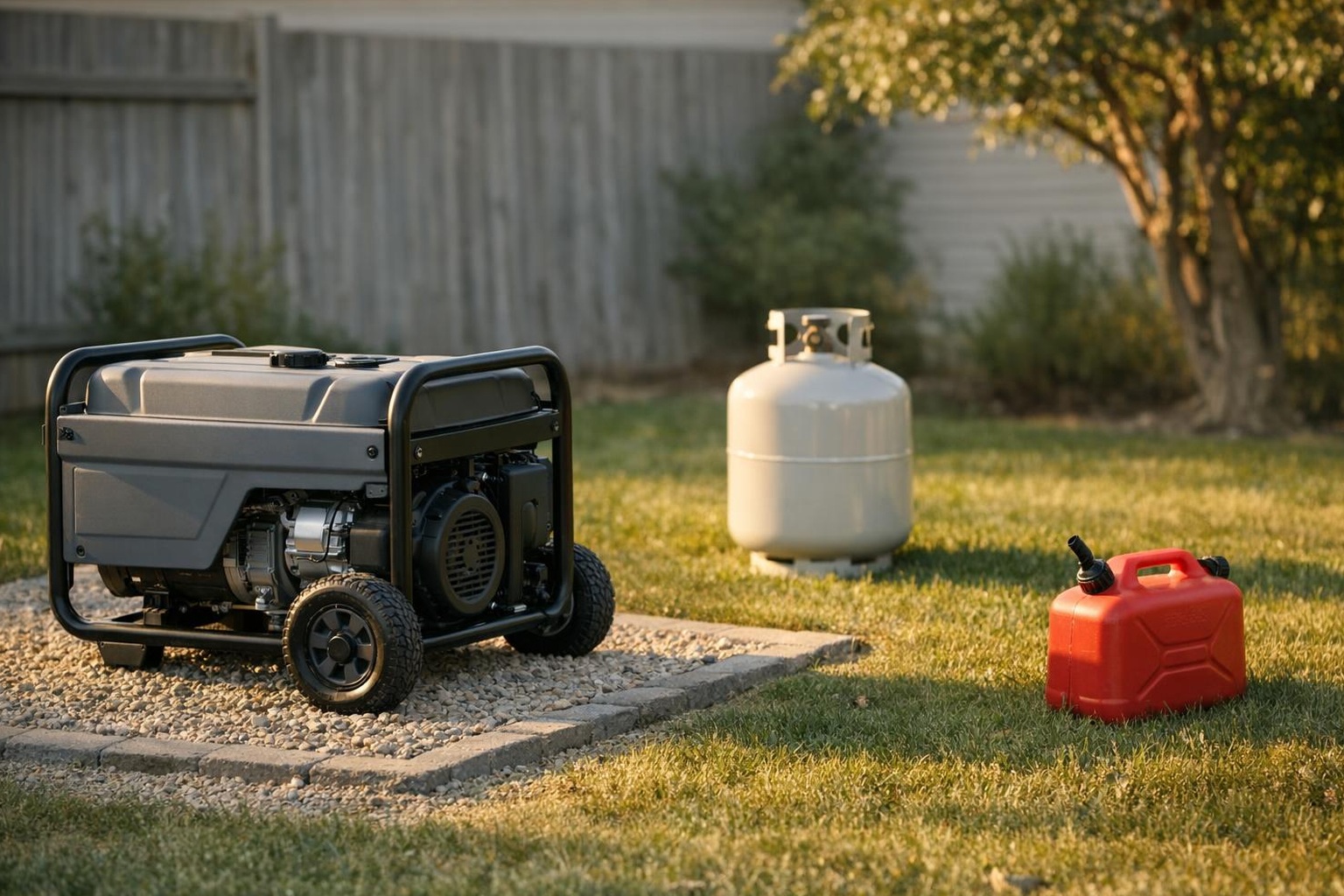
Never operate a generator indoors, in a garage, basement, crawlspace or other enclosed area, even with doors open. Natural gas and propane operation still produce dangerous carbon monoxide. CO shutoff is an additional safeguard, not permission to use an enclosed space. Follow the manual and CPSC generator safety guidance: keep the generator outdoors, at least 20 feet from the home, with exhaust away from doors, windows and vents, and use working CO alarms.
Read the rating evidence at its actual size
Our September 29, 2026 public-page captures identify each exact ASIN and selected title. The counts are Amazon ratings, not counts of written reviews: Westinghouse 1,169; DuroMax 450; Champion 44; WEN four; FIRMAN one. FIRMAN explicitly has zero written reviews. We exclude the 166- and 195-rating Champion family totals because they mix models or fuels.
The published formula’s confidence multiplier is count divided by 50, capped at one. It is 0.88 for Champion, 0.08 for WEN and 0.02 for FIRMAN. Their small samples therefore receive less weight even when an average looks high. No minimum score is imposed on these entries. Ratings do not establish long-term reliability, noise under load or performance on your home’s gas supply.
For the documented component, the formula uses the existing spec-fit calculation where explicit running and peak watts are available, and documentation completeness otherwise. This is why DuroMax and FIRMAN require further manual checks here. We have not load-tested any of these machines. Compare the broader dual-fuel home-backup shortlist if natural gas is not a requirement.
Exact listing sources
Specifications above come from the exact listing receipts captured September 29, 2026 unless a manufacturer source is linked. Captured ratings are a dated snapshot; check the current selected listing, seller and configuration before buying.
How the selection works
We rank category-matching generators only when the exact Amazon product page supplies a verified average and positive review count. Products without that evidence remain in the catalog but are excluded from these shortlists. Order follows the raw editorial score, descending, with listing slug as the stable tie-break. Unless a publisher-assigned exception is identified below, the displayed score is raw divided by ten; genuine ties remain visible. These are research-based editorial ratings, not physical test results.
Manufacturer documentation and exact listing details answer different questions. A seller title identifies the listing but does not prove dimensions, performance or accessory compatibility. We do not award best value without verified prices.
Documented spec fit = 100 × [0.45 × min(running watts / 9,500 W, 1) + 0.35 × min(peak watts / 12,500 W, 1) + 0.20 × min(supported fuel count / 3, 1)], rounded to a whole number. Running and peak watts require explicit roles and units in the exact listing or linked documentation for the exact manufacturer model; manufacturer values here are for gasoline. Bare marketing wattage is not treated as peak output; contradictory values are omitted, not swapped; the fuel count reflects gasoline, propane and natural gas support the listing itself claims. This index summarizes listing documentation for outage sizing — it is not a load test, a noise measurement or a durability judgment.
Documentation completeness = 100 × [0.5 × min(feature bullets / 8, 1) + 0.3 × min(listing images / 5, 1) + 0.2 × (brand stated ? 1 : 0)], rounded to a whole number, computed from the stored Amazon listing record when the listing text does not state both running and peak watts explicitly. It measures how completely a seller documents a listing — nothing about how the generator performs.
Where Amazon publicly displays customer reviews for a listing (average star rating and review count captured from the public product page), the raw editorial score is 100 × [0.45 × (Amazon average / 5) × min(review count / 50, 1) + 0.35 × min(log10(1 + review count) / log10(1 + 5000), 1) + 0.20 × documentation score / 100]. The confidence factor min(review count / 50, 1) damps averages based on very few reviews, and the logarithmic volume term rewards large public review volumes, so widely and highly reviewed listings rank ahead of thinly reviewed ones. Listings with no verified public review data use the documentation score alone in the catalog and are excluded from comparator shortlists. Comparator publication requires at least five review-backed eligible listings per pool. This combined index reflects the public Amazon reputation and the listing documentation — it is not a physical test and not our own product testing.
The displayed editorial rating is the raw 0–100 score divided by ten, shown to one decimal on a 0–10 scale. We do not normalize against the catalog, force endpoints or alter decimals by rank. Genuine ties remain visible; equal raw scores are ordered by listing slug for stability. This is an editorial index, not a physical test or an Amazon customer rating.
Limits and checks before buying
Verify the exact model, current seller, included accessories and instruction manual. For generators, check clearances, outdoor placement and CO safety requirements. Confirm fuel type support and wattage ratings against your exact load plan before buying.
Never assume a shared brand name proves compatibility. Explore all categories and read the generator guides.