
Westinghouse 9,500W Dual Fuel
7.6Very good · out of 10$949 Price on Sep 30, 2026 · may have changed- Stated: 7,500 W running · 9,500 W peak · Gasoline, Propane
- 156 buyer reviews
- Dual fuel generators
Product images: Amazon listings
Written from the listing and 156 buyer reviews, not from our own use · How we rate
The Westinghouse 9,500W Dual Fuel ticks most of the boxes we care about: 7,500 running and 9,500 peak watts, the choice of gasoline or propane and an L14-30R twist-lock for a transfer switch. A strong pick for a home backup plan that doesn't depend on the gas station, and one of our top 5 dual fuel generators under 10,000 watts.
These are sold as variants of one listing family. Each variant has its own page.
| Brand | Westinghouse |
|---|---|
| Category | Dual fuel generators |
| Running output | 7500 W |
| Peak output | 9500 W |
| Listed fuels | gasoline, propane |
| Fuel tank | 6.6 gallons |
| CO sensor | Stated in the listing |
| Transfer switch ready | Stated in the listing |
| Outlets named in the listing | L14-30R, GFCI household |
| Engine | 420 cc |
| Buyer reviews | 156 · 4.5/5 |
| ASIN | B099KPDJBD |
Full listing title: Westinghouse 9500 Peak Watt Dual Fuel Home Backup Portable Generator, Electric Start, Transfer Switch Ready, Gas & Propane Powered, CO Sensor
| Running output | Exact listing |
|---|---|
| Peak output | Exact listing |
#3 of 5 in our Dual Fuel Generators Under 10,000 Watts ranking
What it's made for: a home backup plan that doesn't depend on the gas station.
The two picks next to it in our dual fuel generators under 10,000 watts ranking, with their rating and a dated price.


That's the running figure the listing states, on gasoline. On paper that covers the fridge, the freezer, the sump pump and the lights; central air and a 240 V well pump together are another story.
Why it made our list
Gasoline or propane. Propane keeps for years in a sealed tank and won't gum up the carburetor between storms; gasoline gives you more watts. Propane is rated lower, so find that figure in the manual.
L14-30R twist-lock. A locking 30 amp, 240 V outlet that matches a standard inlet box. With a transfer switch or an interlock fitted by an electrician, whole circuits run off the generator instead of a tangle of cords.
Extension cords: the fridge, the freezer and a lamp or two plug straight into the 120 V outlets on the frame (GFCI-protected, per the listing). It costs little, but the furnace, the well pump and anything hard-wired stay off.
A transfer switch: the listing names an L14-30R twist-lock, and the seller calls it transfer-switch ready. That's the plug an inlet box takes. Once an electrician has wired the inlet and a transfer switch or interlock, the furnace and the well pump can run off it too; count that bill on top.
The seller states, word for word, in the Westinghouse 9,500W Dual Fuel listing:
7500 Rated Watts and 9500 Peak Watts (Gasoline).
Intuitive Control Panel Features Two GFCI 5–20R 120V 20A Household Duplex Outlets and One L14-30R 120/240V 30A Twist-Lock Outlet.
Their words and their figures, not our measurements. How loud it is twenty feet from your bedroom window, and whether it catches your well pump's start-up surge, no listing can tell you.
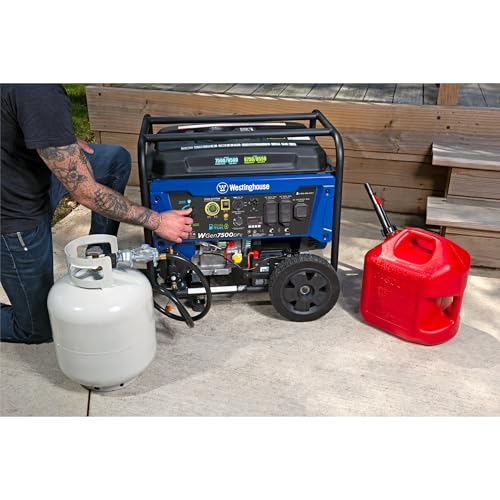
What the Westinghouse 9,500W Dual Fuel listing names:
The manual for the Westinghouse 9,500W Dual Fuel has the final word on fuel, oil and outlet ratings.

At the price on Sep 30, 2026, each 1,000 running watts works out at about $126.53 (price ÷ stated running watts, our arithmetic). That puts it in the cheaper third of the 18 generators of 4,000 to 8,000 running watts we have a price and a stated running figure for.
Add the hookup to the budget: a heavy cord, an inlet box and an electrician's visit for the transfer switch or interlock.
The button opens the exact listing (ASIN B099KPDJBD), where today's price, stock and seller apply. Sizes and variants of the same family often sit at different prices.

Want it quieter, or cleaner power for electronics? The Champion 11,000W Dual Fuel Inverter (7.8/10) is an inverter, per its listing.
Want to hook it to the gas line? The Champion 8,125W Tri Fuel (7.6/10) runs on gasoline, propane and natural gas.
Want a CO shutoff? The WEN DF8000X (7.5/10) names a CO sensor that shuts the engine off.
Our take
We like the Westinghouse 9,500W Dual Fuel for 7,500 running and 9,500 peak watts and the choice of gasoline or propane. 156 buyers give it 4.5/5, which is a solid sign. The one thing that bugs us: no word on the propane rating or the runtime. We'd pick it if you'd rather store propane tanks than cans of gas; otherwise, put it next to the Champion 8,125W Tri Fuel first.
Fill it with oil before the first start, then run it for a few minutes outside with a small load.
Start it with the fob, let it warm up, then add loads one at a time, the biggest motor first. Propane or gas: decide before the storm and have the hose and the tank ready.
Run it every month or so for 20 minutes and keep the battery charged. On propane you avoid stale gas in the carburetor; on gas, add stabiliser or run it dry before storage. Our maintenance schedule has the full list.
First oil change after the break-in hours in the manual (the hour meter counts them), then on schedule. Air filter and spark plug once a season, and a cover for the months it sits.
Buyers give it 4.5/5, a strong record, right on this ranking's 4.5 average. 156 reviews is a fair sample, enough for the average to mean something.
Before the Westinghouse 9,500W Dual Fuel ships, check your load list: 7,500 running watts (9,500 at start-up) have to cover everything you run at once, motor surges included.
Read the label on each appliance (or the manual) for its running watts, and note which ones have a motor. Our running vs starting watts guide explains why the motor ones need the extra surge.
It has an L14-30R outlet, which still needs an inlet box and a transfer switch or interlock installed by an electrician. Our transfer switch guide explains the options.
Outside only, about 20 ft from doors, windows and vents, exhaust pointing away (the CO sensor is a backup, not a permission). Pick the spot now, before the storm. Our CO safety and placement guide has the details.
Gasoline goes stale in a few months without stabiliser; propane keeps. Check the propane rating in the manual if propane is your plan. Our fuel storage guide covers storage.
How the Westinghouse 9,500W Dual Fuel stacks up against the closest alternative in our ranking, the Champion 8,125W Tri Fuel.
| Criterion | Westinghouse 9,500W Dual Fuel | Champion 8,125W Tri Fuel |
|---|---|---|
| Our rating | 7.6/10 | 7.6/10 |
| Running watts | 7,500 W | 6,500 W |
| Peak watts | 9,500 W | 8,125 W |
| Fuels | Gas, propane | Gas, propane, natural gas |
| Start | Remote | Electric |
| Buyer reviews | 156 · 4.5/5 | 165 · 4.5/5 |
Both score 7.6/10. The Champion 8,125W Tri Fuel adds natural gas as a third fuel, while the Westinghouse 9,500W Dual Fuel brings more running watts (7,500 W) and a higher peak (9,500 W).
We rate it 7.6/10 (very good), #3 of 5 in our dual fuel generators under 10,000 watt ranking. It is based on 156 buyer reviews averaging 4.5/5 and the specifications stated in the listing.
The listing or manual states 7,500 W running and 9,500 W peak, usually for gasoline. Size your load list against the running watts and keep the peak for motor starts; propane and natural gas ratings are lower. These are the seller's figures, not our measurements (our sizing calculator turns your loads into a running and peak pair).
The listing names gasoline and propane. Output differs by fuel, so check the per-fuel running watts in the manual and whether the hoses you need come in the box. Run it outdoors only, away from doors, windows and vents.
Its listing states 7,500 running watts (9,500 at start-up), the choice of gasoline or propane, an L14-30R twist-lock for a transfer switch, a built-in CO sensor and remote start from a key fob. These are the seller's figures, not our measurements: how loud it is in your driveway and how it handles your well pump's surge can't be read from a listing.
Your load list: read the label on each appliance (or the manual) for its running watts, and note which ones have a motor. Our running vs starting watts guide explains why the motor ones need the extra surge. How it reaches the house: it has an L14-30R outlet, which still needs an inlet box and a transfer switch or interlock installed by an electrician. Our transfer switch guide explains the options. Where it will run: outside only, about 20 ft from doors, windows and vents, exhaust pointing away (the CO sensor is a backup, not a permission). Pick the spot now, before the storm. Our CO safety and placement guide has the details. Fuel for three days: gasoline goes stale in a few months without stabiliser; propane keeps. Check the propane rating in the manual if propane is your plan. Our fuel storage guide covers storage.
We link to the exact listing on Amazon, where today's price, stock and seller apply. It is an affiliate link, and it has no effect on the rating.
No, we haven't used it ourselves. Everything on this page comes from its listing and 156 buyer reviews, read line by line and weighed with our published formula, plus our editors' read of how it compares with its rivals.
If the Westinghouse 9,500W Dual Fuel hasn't sold you yet, see where it ranks, read the guides that feature it or browse all dual fuel generators.